OPAL | ONE V2.1 — Persistent Atomic Memory Vertex Infrastructure Above the Compute Layer.
“Modern intelligent systems repeatedly recompute semantic state instead of retaining it. This reconstruction cycle drives unnecessary compute, energy consumption, latency, and infrastructure cost. OPAL replaces repeated reconstruction with persistent deterministic semantic memory, allowing intelligent systems to retain state rather than rebuild it.”
OPAL — Validation Complete
Final validation confirms that OPAL’s deterministic semantic substrate scales to tens of millions of Atomic Memory Vertices (AMV) on consumer hardware while maintaining stable retrieval latency, bounded memory usage, and deterministic graph behavior.
Verified Results
59,999,889 logical relationships
119,999,778 directed connections
3-hop traversal (median): 0.291 µs
End-to-end roundtrip (median): 1.93 µs
Stable topology with deterministic validation and zero orphan AMVs
Propagation: PASS
Deterministic replay preserved
11.88× compression (91.6% token reduction)
Provider packet compile time: ~80 µs median
What This Enables
OPAL separates persistent semantic state from repeated inference by maintaining deterministic graph memory that can be queried directly instead of reconstructing context each time.
The same substrate now supports:
Deterministic Retrieval — Microsecond-scale, explainable memory access.
ContextCompiler — Compresses retrieved evidence into compact, deterministic provider packets.
PYAMV SDK — Native Python interface for robotics, AI, and edge applications.
Production Benchmarking — Benchpress-compatible workloads with deterministic performance validation.
Check out on arXiv →
Check out on arXiv →
View benchmark results →
Kindred
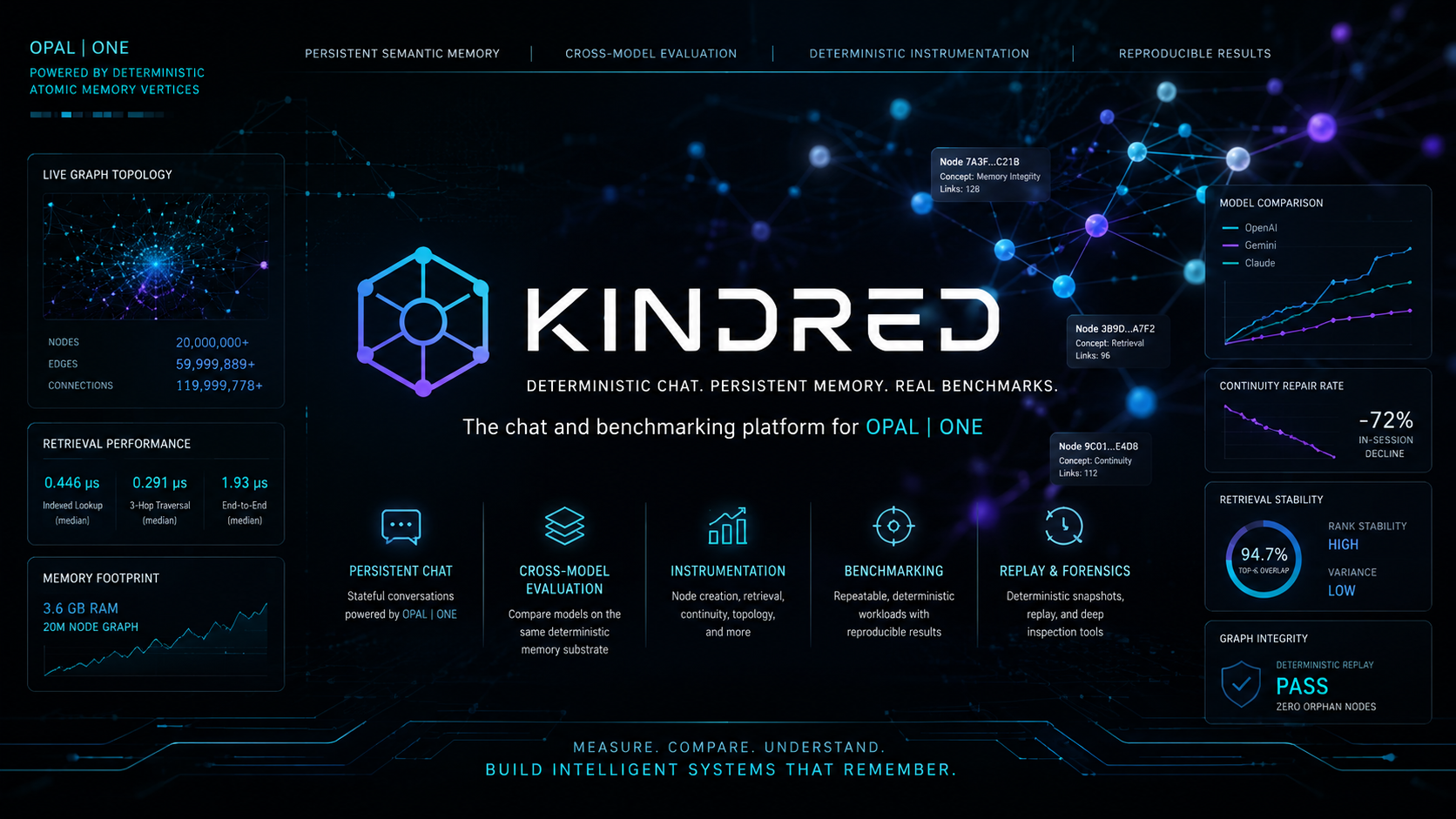
Utility Tools, SDKs, APIs, and Applications Built on the OPAL | ONE Substrate
Kindred is the product layer for OPAL | ONE.
It brings the OPAL substrate into practical use through developer tools, SDKs, APIs, evaluation systems, and end-user applications that share the same deterministic memory foundation.
Every Kindred product is built around the same core idea: persistent semantic state should be inspectable, measurable, reproducible, and portable across models, tools, and workflows.
What Kindred Does
Kindred turns OPAL | ONE into a usable product ecosystem.
It provides deterministic chat, memory instrumentation, replay, benchmarking, cross-model evaluation, and developer-facing interfaces for systems that need persistent semantic memory instead of disposable context windows.
Kindred products are designed for teams building AI systems that must remember, retrieve, compare, audit, and improve over time.
Core Capabilities
- Persistent Semantic Memory — Stateful conversations and tools backed by the OPAL | ONE substrate.
- Deterministic Chat — A production interface for interacting with persistent memory under controlled conditions.
- Cross-Model Evaluation — Compare OpenAI, Gemini, local models, and future providers against the same memory substrate.
- Memory Instrumentation — Measure AMV creation, retrieval behavior, continuity, topology, graph evolution, and propagation.
- Benchmarking — Repeatable workloads with reproducible outputs across models, prompts, and memory states.
- Replay & Forensics — Inspect deterministic graph snapshots, memory propagation, and retrieval decisions after each run.
- SDK & API Access — Build Kindred products directly on top of OPAL | ONE through developer-facing interfaces.
- Utility Tools — Specialized tools for testing, analyzing, compressing, and operating semantic memory systems.
Cross-Model Memory Propagation
Kindred can execute identical prompt sequences while holding the memory substrate, retrieval pipeline, write pathway, benchmark configuration, and replay environment constant.
Only the upstream language model changes.
This makes it possible to measure how different models behave against the same persistent semantic state. Each run records graph evolution, retrieval behavior, continuity metrics, propagation patterns, and replayable snapshots.
The result is a controlled environment for understanding how models interact with memory, not just how they respond to prompts.
What Kindred Measures
- AMV creation and relationship growth
- Semantic graph topology
- Retrieval stability
- Continuity behavior
- Memory propagation
- Context reuse and drift
- Deterministic replay validation
- Cross-model variance
- Benchmark reproducibility
- Substrate-level state evolution
On-Device Continuity for Robotics and Autonomous Systems
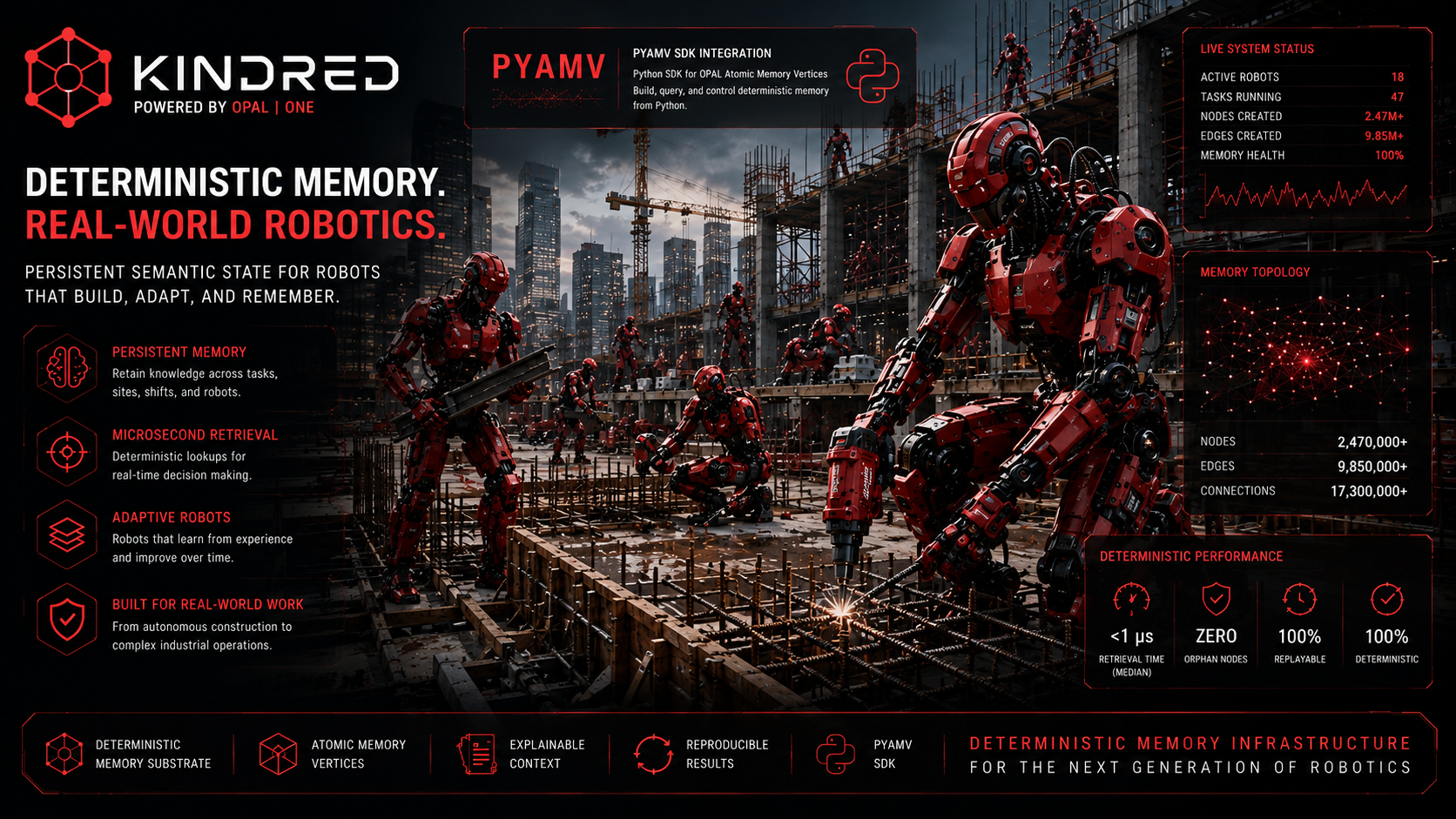
Robotic and autonomous systems become fragile when continuity depends on cloud round trips.
In many autonomy stacks, sensor data is uploaded, inference or learning happens remotely, and updated state is sent back into the control loop. When bandwidth throttles, latency spikes, or connectivity drops, the system operates on stale state. That can cause hesitation, unstable recovery, degraded navigation, or full mission resets.
OPAL | ONE moves continuity out of the network path.
Instead of treating memory as remote context, OPAL persists semantic and operational state locally in a deterministic, addressable graph. Learned priors, environment structure, goals, constraints, observations, and retrieval paths can remain available on-device, even when cloud access is limited or unavailable.
After restart, degradation, or interruption, recovery becomes a bounded local read and traversal operation, not a cloud-dependent re-inference loop.
Common Failure Modes in Deployed Autonomy Stacks
Learned priors, maps, mission goals, constraints, and behavioral context live off-device and must be re-fetched, replayed, or reconstructed after interruption.
2. Latency-bound recovery
State rehydration depends on remote inference or synchronization, adding delay and power spikes during the exact window where recovery needs to be fast.
3. Unstable replay
When memory is implicit, transient, or distributed across remote services, identical scenarios do not reliably reconstruct the same internal state.
4. Battery-expensive continuity
Repeated cloud calls, large sensor uploads, and redundant recomputation consume power that should be reserved for sensing, control, and mission execution.
5. Bandwidth-limited learning
Vision, lidar, telemetry, and event streams generate more structure than many field systems can continuously upload. Valuable local state is dropped, compressed away, or delayed.
OPAL | ONE Keeps Working When the Network Does Not
OPAL | ONE is designed for local continuity under constrained compute, battery, and network conditions.
The substrate stores memory as a deterministic graph, allowing systems to keep semantic state close to the control loop. Vision events, lidar-derived structure, object relationships, spatial observations, mission constraints, and prior decisions can be encoded as addressable graph state instead of disposable context.
That means the cloud changes roles.
Training, fleet aggregation, analytics, and model updates can still happen remotely, but they no longer need to sit inside the critical control path. Bandwidth throttling affects update velocity, not local coherence. Connectivity loss limits synchronization, not the system’s ability to recover its own state.
Local Graphs for Vision, Lidar, and Mission Memory
Autonomous systems do not only need raw perception. They need continuity across perception.
A camera frame, lidar sweep, obstacle detection, route correction, operator command, and prior mission outcome become more useful when connected. OPAL allows those relationships to accumulate locally as graph state.
This is especially important for systems with limited battery or intermittent cloud access. Instead of repeatedly uploading sensor context or recomputing state from scratch, the system can reuse local graph structure:
- Vision observations can link to objects, scenes, classifications, and prior detections.
- Lidar events can connect to spatial regions, obstacles, traversability, and map updates.
- Mission state can persist across restarts, degraded links, and partial failures.
- Recovery can traverse known local structure instead of waiting for remote reconstruction.
- Learning compounds in place as the graph grows from thousands to millions of connected states.
DCPerf Workbench Results
In DCPerf Workbench throughput testing, OPAL demonstrated high-volume local graph operations:
- Lookups: 292,397 ops/sec
- Ingest: 212,613 ops/sec
- Graph Traversals: 104,239 ops/sec
- Recall: 71,916 ops/sec
These results matter because autonomy workloads are not one operation. They require continuous ingest, lookup, traversal, recall, and replay under tight resource constraints.
For robotics, drones, field systems, embedded agents, and sensor-heavy platforms, this means OPAL can support fast local memory operations without assuming unlimited bandwidth, persistent cloud access, or remote inference availability.
The Direction
OPAL | ONE is built for systems that need continuity to survive outside ideal network conditions.
Kindred products will expose this substrate through utility tools, SDKs, APIs, benchmarks, and reference applications. The goal is to make persistent semantic state usable across robotics, autonomy, developer infrastructure, evaluation, and AI systems that need memory to be deterministic, inspectable, and operationally reliable.
The long-term direction is clear: AI systems should not lose coherence because the network changed.
Memory should be local when continuity matters, deterministic when recovery matters, and measurable when systems are deployed in the real world.
DCPERF VALIDATION
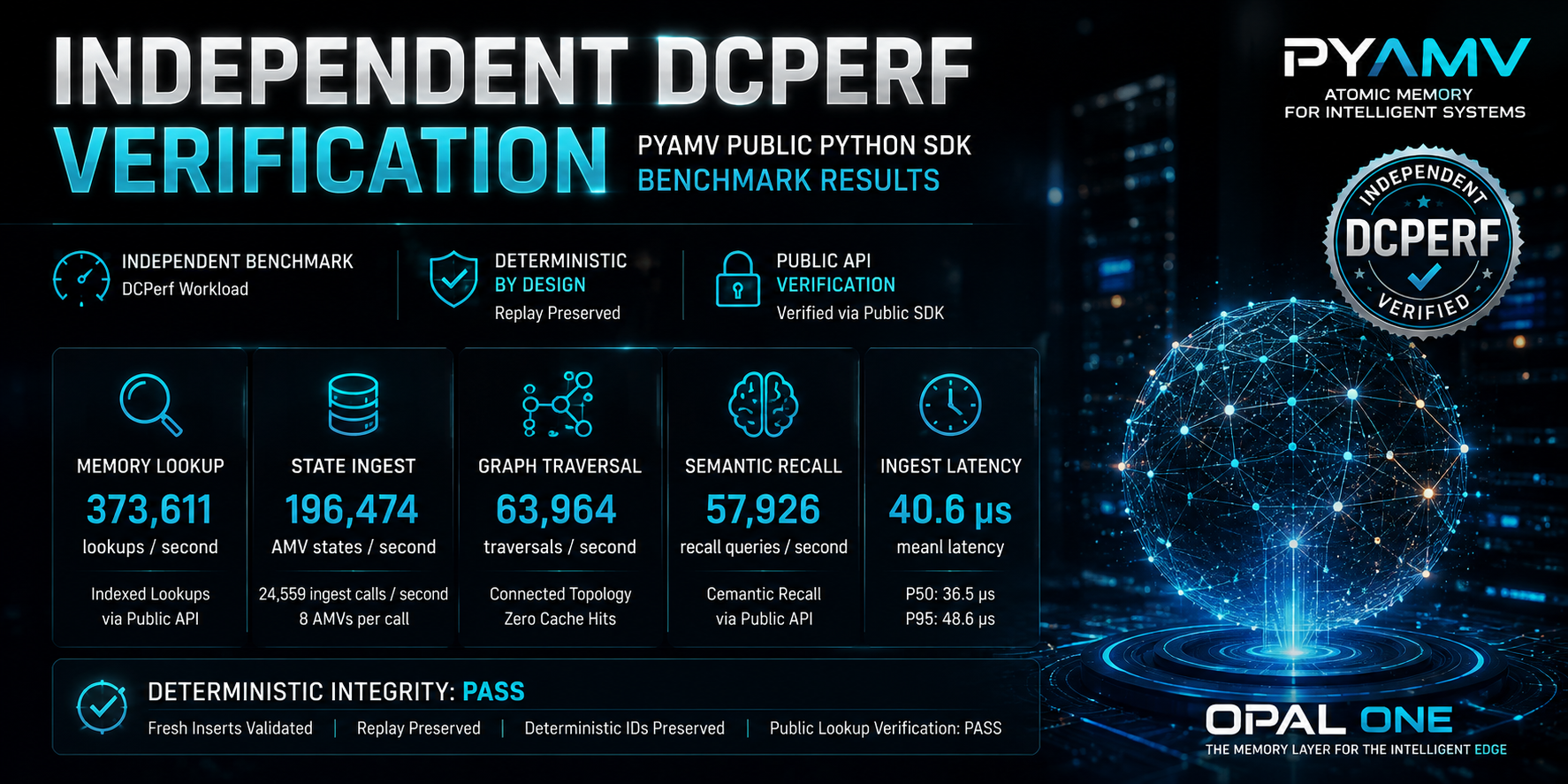
I wanted to know what PYAMV actually looks like outside our own OPAL benchmarks, so I put it through DCPerf using the same public Python API a developer would call. No internal shortcuts, no benchmark-only fast paths—the test hits real lookup, ingest, traversal, and recall operations, with the topology, replay integrity, runtime, and native build verified along the way. Here’s what it did.
57,926 recall queries per second
373,611 indexed memory lookups per second
DCPerf workload executed through the PYAMV public API
1,000 measured iterations
100 warmup iterations
63,964 connected graph traversals per second
Validated connected topology
Zero traversal cache hits
24,559 ingest calls per second
196,474 AMV states ingested per second
8 AMVs per ingest call
Mean ingest latency: 40.6 µs
P50: 36.5 µs
P95: 48.6 µs
Fresh inserts validated
Replay preserved node and edge counts
Deterministic IDs preserved
Public lookup verification: PASS
Python/native ABI match: PASS
Native module SHA-256 recorded
Canonical benchmark artifact preserved
PYAMV is launching soon. The memory layer for intelligent systems is almost here.
Live Discussion
This discussion reflects real-world reactions and technical debate around OPAL | ONE. The system is being challenged publicly under live conditions, with reproducible benchmarks and measurable constraints.
The Bottleneck Is Repeated Reconstruction

Cloud AI has been optimized for faster inference. OPAL | ONE targets a different bottleneck: repeated reconstruction.
Most AI systems rebuild semantic context continuously. They stuff prompts, regenerate embeddings, re-rank retrieved context, and re-infer state at every interaction or control cycle. Compute is spent reconstructing information the system has already observed instead of advancing the task.
At scale, that loop increases GPU utilization, network dependency, thermal load, latency variance, and failure sensitivity under throttling or degraded connectivity.
OPAL | ONE reduces reconstruction by persisting semantic state as a deterministic graph.
Memory is encoded once, stored locally or near the application, and traversed as addressable state. Meaning does not need to be repeatedly approximated through prompt replay when the relevant state already exists in the substrate.
The result is not simply faster inference. It is less unnecessary inference.
In steady-state operation, more work collapses into bounded graph traversal: prompts can shrink, external calls can drop, recovery becomes more predictable, and continuity can hold under sustained load.
Reference Results
| Graph Size | Compression | Recall | Traversal |
|---|---|---|---|
| ~106 AMV | 96.8% | Lossless | ~0.29 ms |
| ~107 AMV | 97.1% | Lossless | ~0.31 ms |
| ~108 AMV | 97.2% | Lossless | ~0.32 ms |
• No observed semantic drift
• No observed fragmentation
• No observed traversal latency degradation
• Deterministic rollback on invalidation
These results show stable compression, lossless recall, and bounded traversal behavior from million-AMV to hundred-million-AMV graph scales.
A native macOS utility that brings deterministic semantic memory to AI coding assistants. The utility investigates repositories, ranks relevant code evidence, compiles compact provider packets, and supplies explainable, token-efficient context to Claude, Codex, and future agent platforms. Built around Sizler, ContextCompiler, and OPAL | ONE, it is designed to reduce prompt size, improve context quality, and provide measurable token and cost savings without modifying the underlying language model.
Deployment of OPAL | ONE on NVIDIA Jetson platforms for robotics, autonomous systems, and edge AI. This phase validates deterministic semantic memory on resource-constrained hardware while providing persistent state, microsecond-scale retrieval, and low-power operation suitable for real-time robotic and embedded applications.
Native ARM NEON acceleration for OPAL’s core mathematical and graph-processing routines. NEON optimizations target vector operations, similarity calculations, retrieval scoring, and semantic processing to improve throughput, reduce latency, and maximize performance across Apple Silicon, Raspberry Pi, Jetson, and other ARM-based edge devices.



The Space Race: Cooling the AI Cloud
AI cloud providers are in a modern space race: more inference, more throughput, more density — and relentless pressure to keep silicon within safe thermal limits. The constraint is not just compute; it’s power delivery, heat removal, and the cost of sustained cooling at scale. Opal One targets the waste inside the loop by preserving deterministic semantic state so systems do not repeatedly rebuild the same context. When redundant work is removed, less energy turns into heat — which reduces thermal load, lowers the cooling burden, and eases hardware pressure under steady-state operation. Modeled visualization: the chart below uses a public baseline for U.S. data-center electricity use and applies a user-controlled annual growth rate to show how demand can scale over time. Real-world outcomes vary by workload, hardware, and deployment.
U.S. primary energy consumption (2023): 93.59 quads (≈ 9.87×10¹⁹ J/year). Data centers (DOE/LBNL 2023): 176 TWh/year (≈ 6.34×10¹⁷ J/year). Source: DOE/LBNL; EIA for primary energy. Conversion: 1 TWh = 3.6×10¹⁵ J.
In conventional AI systems, a large share of energy consumption is driven by repeated model inference, embedding regeneration, memory bandwidth pressure, and the thermal overhead required to sustain those cycles. Industry analyses consistently show inference and data movement as dominant contributors to AI power draw.
Opal One’s benchmarks demonstrate deterministic compression and preserved semantic state, allowing systems to avoid repeated re‑inference during steady‑state operation. When inference‑driven compute is reduced, overall system energy demand can decrease proportionally.
The slider explores modeled scenarios only. For example, if inference accounts for a large fraction of total energy use, eliminating that work could yield up to ~25% system‑level energy reduction, depending on workload mix and deployment scale. These are not empirical guarantees.
Context sources: U.S. DOE data center energy reports; industry analyses from Google, NVIDIA, and McKinsey identifying inference, memory bandwidth, and thermal management as primary AI energy drivers. Measured metrics (Joules/query, $/hour, thermal envelope) will replace this model once instrumentation is complete.